May 25th: Reflections from 1 Chronicles 23–25

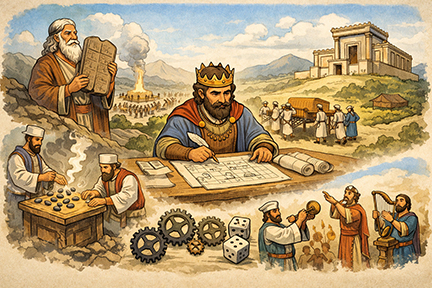
This morning’s reading was 1st Chronicles 23–25. If I’m being honest, this is the kind of passage that can feel a little slow (boring) at first. There's a lot of lists made up of unfamiliar names. It can be really easy to read past.
But as I slowed down, I found myself asking questions—and those questions started to reveal something deeper, important, and interesting.
One of the first questions was, “Why is Moses mentioned here?” This is David’s time. So why bring Moses into it?
“Now the sons of Moses the man of God were named among the tribe of Levi.” (1 Chronicles 23:14)
What became clear is the unfolding nature of God's plan. Moses was used to lay the foundation. David was then organizing what God was doing next.
That spoke to me. God’s work is consistent across generations. What He begins, He continues. Leadership isn’t about reinventing—it’s about entering into God's revealed plan.
The next question came when David said the Levites would no longer carry the tabernacle, “Why is that?”
“Also, the Levites will no longer need to carry the tabernacle and all its utensils for its service.” (1 Chronicles 23:26)
For years, the Levites were responsible for carrying the tabernacle and its utensils. That made sense in the wilderness—everything was moving. … But now? Israel is settled. The temple is coming. Worship is about to be centralized. So, the assignment needed change. Not because the ultimate mission changed—but because the next step in God's unfolding plan was revealed.
That was a good reminder for me: What God requires in one season may not be what He requires in the next. But faithfulness is still necessary.
And then the question became, “What were the lots all about?” … those repetitive (boring) lots with so many unfamiliar names. In chapter 24, David organizes the priests into divisions and casts lots to determine their order of service.
“Thus they were divided by lot, one as another; for they were officers of the sanctuary and officers of God, both from the sons of Eleazar and the sons of Ithamar.” (1 Chronicles 24:5)
The biblical practice of casting lots feels random. But it was God's given practice. The lot wasn’t about chance—it was about trust. It removed favoritism, removed preference, and placed the outcome in God’s hands.
God determined who served when. And it reminded me that the system carried forward,
“Now it happened that while he was performing his priestly service before God in the appointed order of his division… he was chosen by lot…” (Luke 1:8–9)
That’s Zechariah—John the Baptist’s father. God used a structured system, put in place generations earlier, to introduce a new paradigm shift in His unfolding plan. It reminded me that God works through structure, not just in spontaneity.
There were different lots cast that could easily be missed, if we get lost in the repetitive nature of the lists, “What about the musicians?”
In chapter 25, David shifts to worship leaders—musicians.
“Moreover, David and the commanders of the army set apart for the service some of the sons of Asaph and of Heman and of Jeduthun, who were to prophesy with lyres, harps and cymbals…” (1 Chronicles 25:1)
And just like the priests,
“They cast lots for their duties, all alike, the small as well as the great, the teacher as well as the pupil.” (1 Chronicles 25:8)
Which means worship wasn’t random either. It was organized. Intentional. Even described as prophesying.
And this emphasized something important: Not everyone had the same role.
- Priests handled sacrifices
- Musicians led worship
- Levites supported the work
Different roles—but all serving the same purpose.
That’s a helpful reminder. Unity doesn’t mean sameness. It means alignment. For us, we have different spiritual gifts but are used to accomplish the same mission.
So, what do we do with all of this?
What started as a “detail-heavy” (boring) section turned into something interesting and helpful.
God is not a God of chaos. He orders things. He assigns roles. He works through systems. He builds in seasons. And He does it all with purpose.
What looks like small details is actually a picture of long-term faithfulness. This section didn’t come with a dramatic moment—but it gave me something just as valuable: clarity.
- Stay faithful in what God has given you.
- Trust where He has placed you.
- And don’t overlook the structure—God is working in that too.