May 23rd: 2nd Samuel 24, 1st Chronicles 2–22, Psalm 30

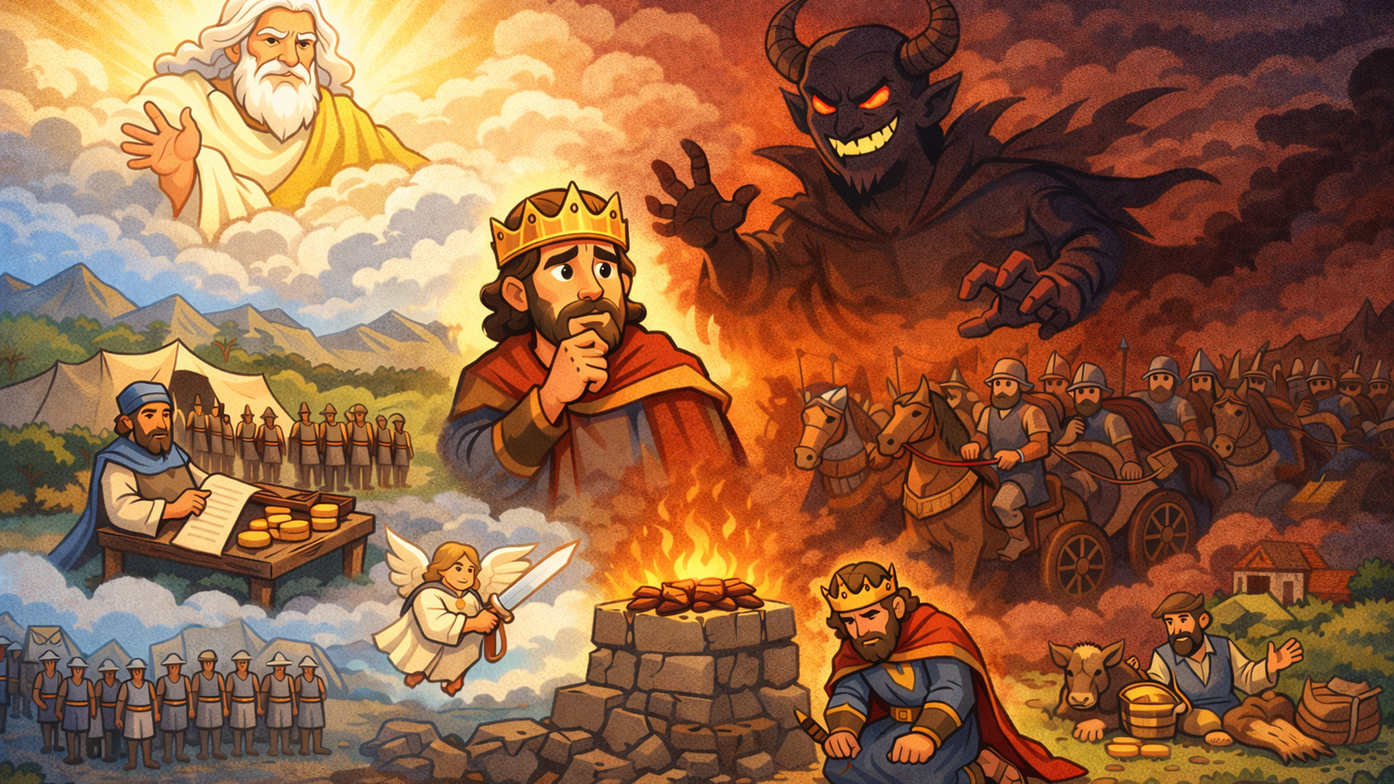
In today’s reading we are presented with one event—census—with what appears to be two different catalysts that set it in motion.
In 2nd Samuel 24, we read that the anger of the Lord burned against Israel and how He allowed David to be incited to number the people. In 1st Chronicles 21, we are told that Satan stood up against Israel and moved David to take the census.
These two narratives do not contradict but rather give insight: God tests, Satan tempts and we choose. It reminds me of a deep dive into the first chapter of the book of James. James uses the same Greek word for both testing and tempting. God may allow a test that exposes what is in our hearts, but He never tempts anyone to sin (James 1:13). The test reveals where our dependence in God lies, while the temptation is Satan’s attempt to pull us toward dependence on ourselves.
Counting people was not always forbidden in Israel (Numbers 1 and 26). The problem in David’s case was what the counting represented. David was measuring the strength of his kingdom by the size of his army rather than resting in the strength of God. Instead of trusting that the Lord was Israel’s defender, he looked to the numbers of his fighting men.
Like the book of James, testing to tempting is a subtle shift from the victory of depending on God to the failure of trusting in our own strength.
When David realized what he had done, conviction came quickly. Scripture says his heart troubled him. There’s another lesson to take note of here: When God speaks to our hearts, the responsibility is personal.
At the threshing floor of Ornan, we see that moment unfold. Ornan generously offered David everything—the land, the oxen for sacrifice, and the wood for the altar. But David refused.
“No, but I will surely buy it for the full price; for I will not take what is yours for the Lord, or offer a burnt offering which costs me nothing.” (1 Chronicles 21:24)
David understood something vital about repentance. No one else can respond to God for you. Others may support us, encourage us, or make the path easier, but when God calls our hearts to turn back to Him, the response must be our own.
True repentance always costs something.
But thanks be to God, the story does not end with judgment. It ends with mercy. The place where David offered that costly sacrifice became the very location where the temple would later be built (1st Chronicles 22). Out of David’s failure, God established a place of worship and forgiveness for generations.
Psalm 30 captures David reflecting on this very experience. He writes:
“For His anger is but for a moment, His favor is for a lifetime; Weeping may last for the night, But a shout of joy comes in the morning.” (Psalm 30:5)
David had felt the weight of conviction. He had seen the consequences of misplaced trust. But he had also experienced the mercy of God.
The lesson is timeless. It is easy for our hearts to start trusting in resources, strength, influence, or security that we can measure. But God calls His people back to a deeper truth:
Victory never comes from what we can count. It comes from the God we trust.